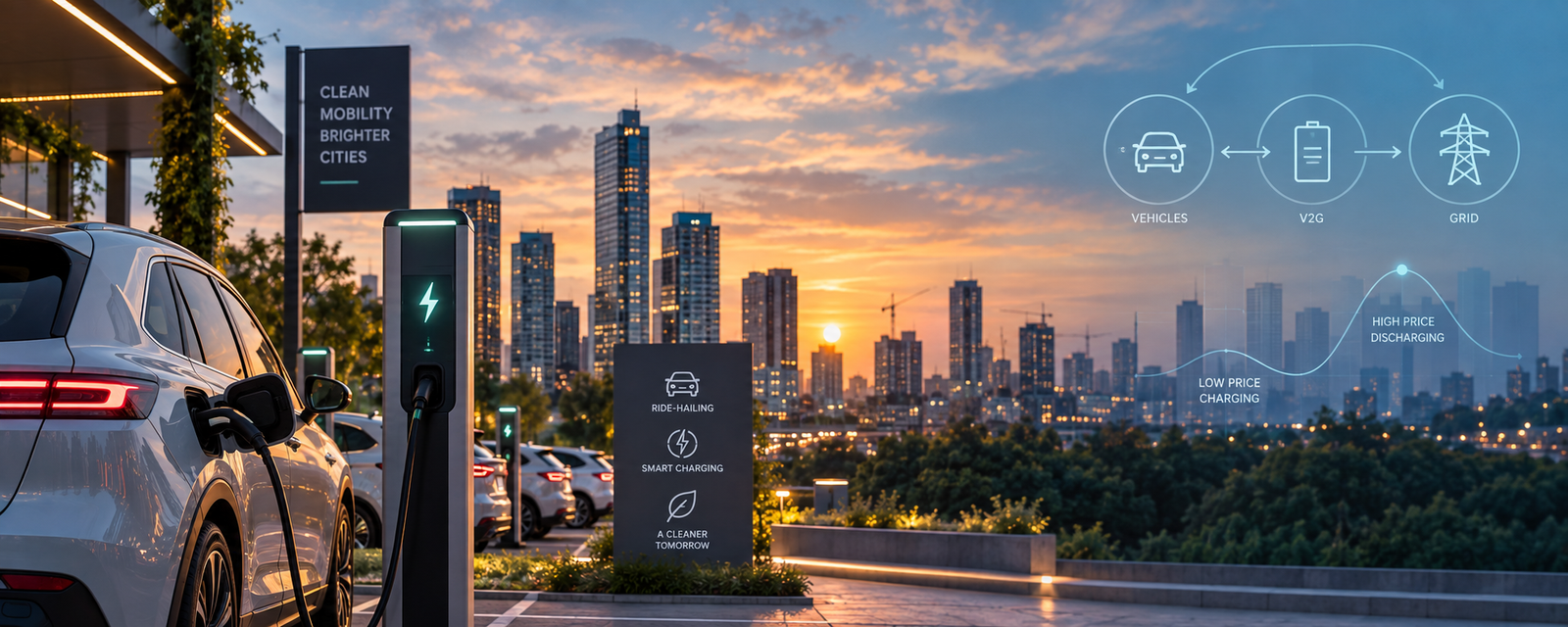
Vehicle-to-grid technology turns an electric fleet into a mobile energy resource. The same battery must still deliver trips, so charging and discharging decisions affect vehicle availability, service quality and traffic. The study asked when energy arbitrage adds value to a ride-hailing operation and how fleet size, trip demand and electricity prices change that result.
Methods and data
A two-sided platform model for users, vehicles and the operator was connected to Aimsun Next and Aimsun Ride, allowing disaggregated service vehicles to interact with background traffic. Three strategies were compared: charging when needed, smart charging at low prices, and bidirectional vehicle-to-grid operation. A systematic experiment varied 500 to 3,000 daily trips, fleets of 50 to 400 vehicles, three electricity-price schedules and six demand-priority settings. Vehicles had 40 kWh batteries. A second search varied charge and discharge thresholds from £0.20 to £0.40 per kWh.
Findings
With optimised thresholds, vehicle-to-grid operation increased average daily profit by 18.08% under the basic price schedule, 18.52% under the time-of-use tariff and 17.70% under volatile prices compared with the conventional fleet. Unfulfilled trips remained below 1% across the optimised configurations, with the highest reported rate 0.87%. Energy arbitrage produced approximately £20 to £25 per vehicle per day. Fixed thresholds performed much worse: under peak demand, a fleet of about 300 vehicles was needed to fulfil more than 95% of requests. The most effective schedules concentrated discharge in a narrow evening price peak.