Travellers choose routes and departure times in response to congestion. At the same time, a shared autonomous vehicle operator links bookings into vehicle chains. Optimising the fleet against a fixed network can therefore miss the feedback between operator decisions and user behaviour. The study formulated a combined Dynamic User Equilibrium and Shared Autonomous Vehicle Chain Formation problem in which both sides reach a Nash equilibrium.
Methods
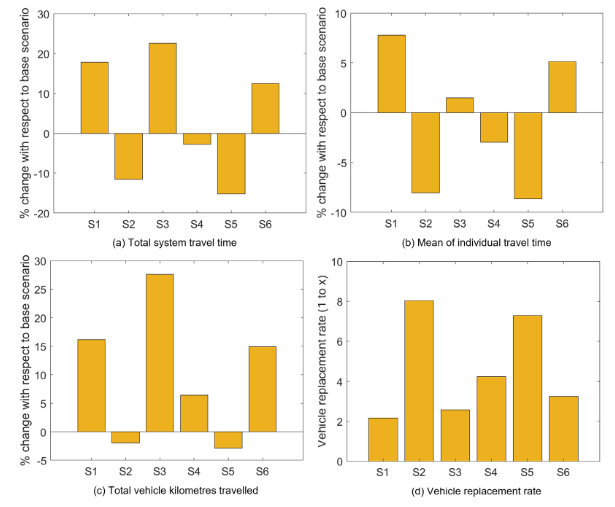
The bilevel model solves traveller assignment as a fixed-point problem and SAV chain formation as a linear programme, then alternates between them through Iterative Optimisation and Assignment. Tests on a two-node network, a Braess network, Sioux Falls and Anaheim examined convergence and scale; 411 combinations of penetration and occupancy were also run. The policy scenarios used the Sioux Falls network with 16,896 trips, compared 10% and 20% SAV penetration, and distinguished carsharing, ridesharing at occupancies of two or three, and a mixed service.
Findings
The 20% ridesharing scenario with three passengers performed best. Total system travel time fell from 9,434 to 8,001 hours, a 15.2% reduction; vehicle kilometres fell from 191,662 to 186,091; and the number of vehicles used fell from 16,896 to 13,925. Each SAV replaced 7.3 vehicles on average in that scenario. By contrast, 20% carsharing increased total travel time by 22.5% and total vehicle kilometres by 28%, largely because of empty trips. Most of the 411 robustness scenarios converged within ten iterations.