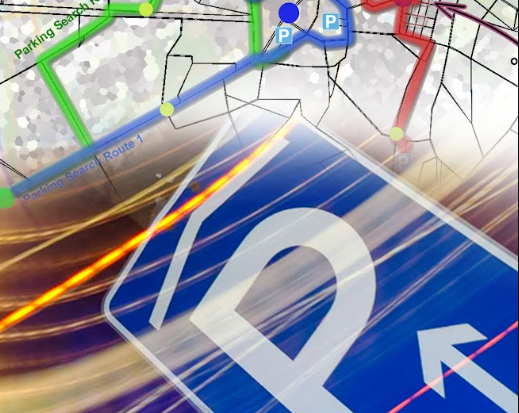
Parking occupancy is both an outcome of demand and a cause of traffic. Drivers may pass several locations, weigh price and walking distance against the chance of finding a space, and add congestion while searching. Conventional assignment models often simplify this process. Our research defined a parking search route as an ordered sequence of parking locations and asked how those routes settle into equilibrium when availability and traffic depend on everyone else’s choices.
Methods
The model combines random-utility route choice with stochastic user equilibrium, extending Wardrop’s principle to parking search routes. A simulated queue at each parking location calculates the probability of finding a space under first-come-first-served or random service, including a maximum acceptable search time. An iterative algorithm updates route flows, network travel times, parking probabilities and route costs until they all converge. Synthetic experiments tested the properties; a real application in Assen, NL used seven origin-destination pairs, six parking locations, approximately 3,400 vehicles, 3,256 spaces and about 120 possible search routes.
Findings
The dynamic Assen experiment reproduced plausible filling patterns: the free car park filled first, smaller facilities reached capacity earlier, and drivers abandoned routes that began at locations with very low availability. In the real-city scenario, reservation users averaged 8 minutes 27 seconds or 8 minutes 26 seconds of travel, compared with 9 minutes 41 seconds in the base case; effects on non-users were small. Drivers searching on street averaged 25 minutes 25 seconds when 5% searched on street and 26 minutes 53 seconds when 15% did so, roughly three times the corresponding off-street travel time.