Environmental impacts of shared e-scooters
Shared scooters can cut emissions, but their benefit depends on how they are operated and which journeys they replace. The project developed a transparent framework for estimating the lifecycle emissions of shared e-scooters and applied it to real-world operations and trip data from Bristol. The analysis examined not only the emissions associated with manufacturing and operating e-scooters, but also which transport modes e-scooter journeys replaced, allowing their impacts on emissions, congestion and journey times to be assessed.
Methods
In this study, we combined an ISO 14040-aligned lifecycle assessment of the Voi V5 scooter with operational data and 190,932 Bristol trips recorded between August and October 2021. The assessment covered materials, manufacturing, transport, charging, maintenance, support travel and end of life.
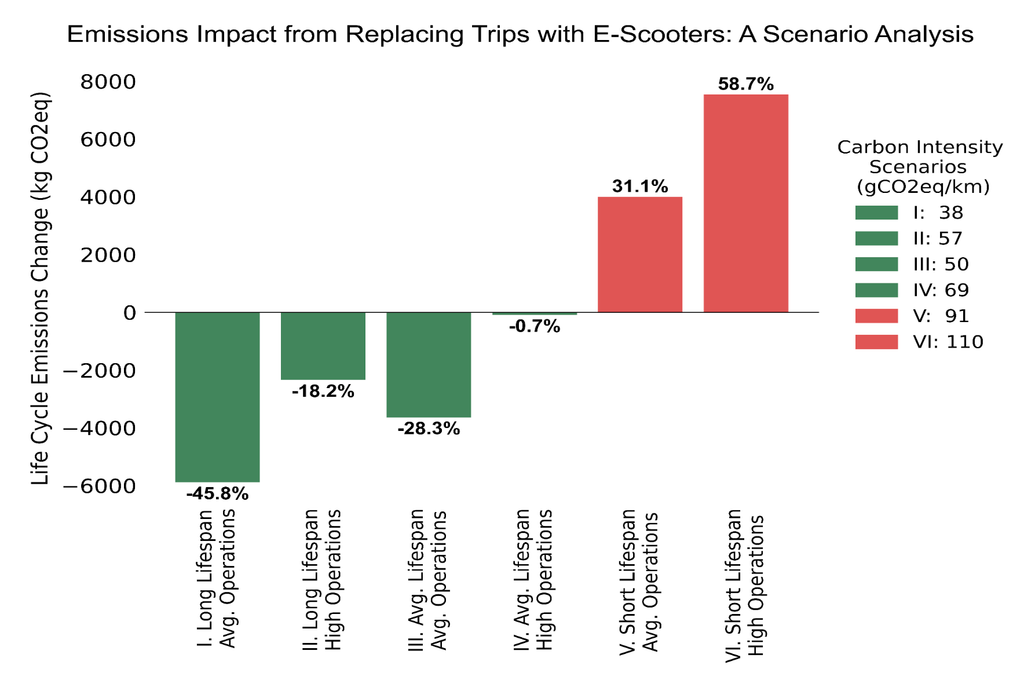
Operational intensity was estimated from 120,449 fleet-service shifts across 87 cities after data cleaning. A cleaned, randomly sampled set of 73,507 Bristol trips then supported comparisons with the modes riders said they would otherwise have used, using route alternatives from Google Directions. Six scenarios tested lifetime distances of 3,000, 6,529 and 10,000 km under two levels of support travel.
Findings
The most favourable scenario estimated 45.8% lower CO2-equivalent emissions than the substituted journeys. Both scenarios assuming a lifetime distance of only 3,000 km increased emissions. Within the sampled trips, the model estimated that scooters displaced 48,762 km of motorised travel, including 15,811 km during peak periods, and saved riders an estimated 2,240 hours at peak times.
The stated alternatives also explain the result: 37% of trips replaced walking, 19% replaced car travel, 14% replaced bus and 10% replaced cycling. Longer vehicle life, efficient servicing and replacement of motorised trips therefore determine whether the carbon balance improves.